Happy first day of autumn!!! Summer 2022’s reading list is late because I am a mom, a busy woman, and yes, a procrastinator. You can call it your Fall Reading List if you prefer.
Favorite books I read this summer
I did get to rev up the reading a little this summer (compared with my feasible reading accomplished over the past couple of years chasing my little guy around), with trips to visit family and a beach vacation. There’s nothing I like better than digging my toes in the sand, feeling the sea breeze on my shoulders, and reading a book, the pages just a little damp from the salt air…
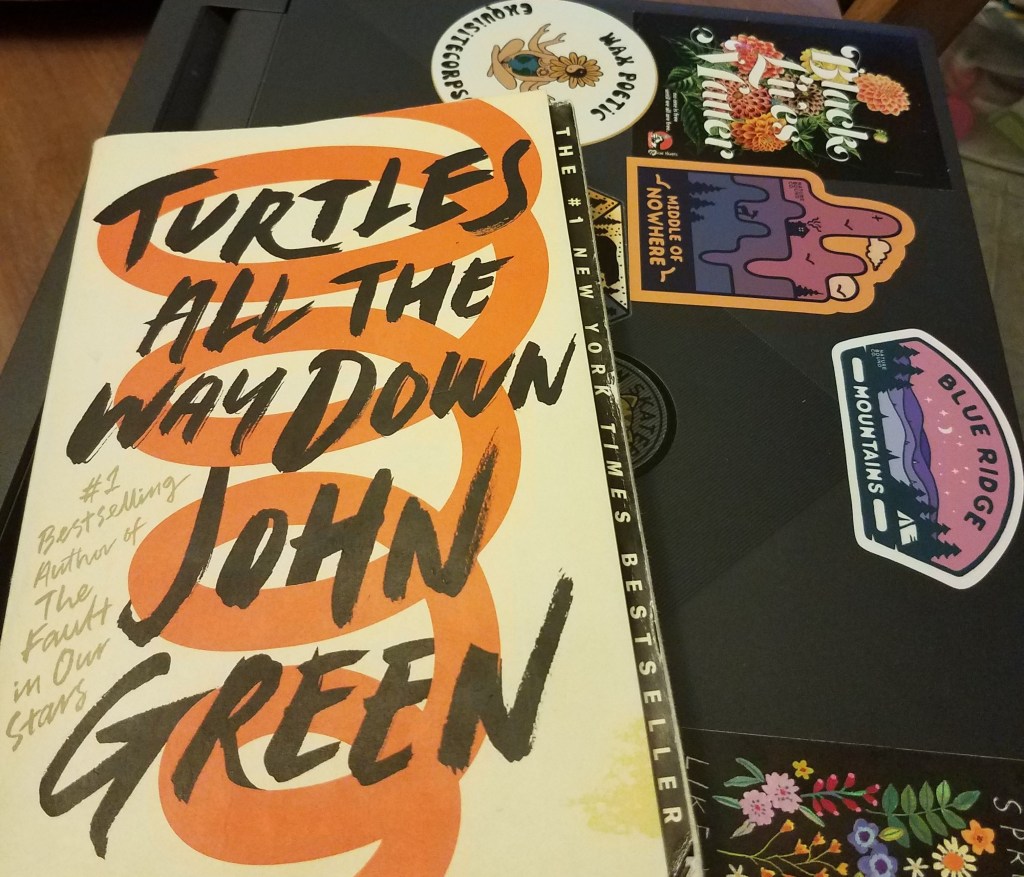
Turtles All the Way Down (John Green)
This book was my most beloved read of the summer. If you know me, you know I love realism, and this book delivers reality portrayed lyrically. It’s YA, actually a recommendation from a high schooler I used to teach. I am also a big fan of YA, so there will be more of that on my book lists.
“I was so good at being a kid, and so terrible at being whatever I was now.”
Turtles All the Way Down by John Green
Last summer (2021) I wrote a similar line in my own notebook as I watched a crew of kids on beach cruisers ride the beachfront together. Our narrator, Aza Holmes a.k.a. “Holmesy” and her bestie Daisy have been lifelong friends. They have adventures (investigations, really… a missing person investigation to be precise), get into trouble, and face challenges together. No other challenge is quite as daunting or longterm as Aza’s overthinking, spiralling mind — she possesses a hyperawareness of some things that produces a lack of awareness for other things which I identified with, and I’m positive has resonated with other anxious souls.
But her mind is also beautiful, and those that she loves see that, despite Aza’s own blindness to it. No spoiler alerts, but endearing conversation between Aza and her love interest Davis made this book a page turner I didn’t want to put down. There is no absence of quotable lines, many that gave me goosebumps. Like this one:””
“And we’re such language-based creatures that to some extent we cannot know what we cannot name. And so we assume it isn’t real. We refer to it with catch-all terms, like crazy or chronic pain, terms that both ostracise and minimise. The term chronic pain captures nothing of the grinding, constant, ceaseless, inescapable hurt. And the term crazy arrives at us with none of the terror and worry you live with.”
Turtles All the Way Down by John Green
And this one:
“What I love about science is that as you learn, you don’t really get answers. You just get better questions.”
Turtles All the Way Down by John Green
I could go one, but I’ve more books to capture for your escape…
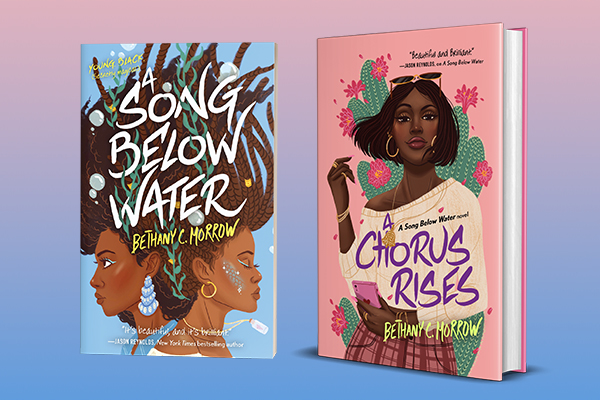
A Song Below Water (Bethany C. Morrow)
I wouldn’t call this one a page turner, but that’s more because it’s a book to sit with. As it should be with a human-rights-Black-girl anthem in the form of well-researched and intricately thoughtful mythos. You should need time to digest what you’re reading — the reality of another consciousness that you have never experienced (unless you’re a Black woman).
“That’s how it is for Black women and girls most of the time. …the only ones who seem to stand for Black girls are Black girls.”
A Song Below Water by Bethany C. Morrow
You can tell I like YA, but what you may not know is that I live for mythology and folklore of all cultures. I’ll be sharing writings in the future from my research and wonderings about archetype, religion, faith, and humanity through lore. A Song Below Water‘s main character energy comes from a secret siren, Tavia, and her sister Effie. The duo, along with a collection of mythical human-beasts (like gargoyles, elokos, and sprites) ticked quite a few boxes for me. And as much as Morrow’s prose broadened my scope of awareness, it also hit home with some universally sensated themes.
I’m watching someone give an account of me based on what they already thought, and there’s nothing I can do about the fact that it’s mostly lies.
A Song Below Water by Bethany C. Morrow
So just because the beginning of this book doesn’t move like a Stephen King novel doesn’t mean you should put it down. Its value is worthy of the long-game read.
12 books that define Lorna (of personal importance to me)
& some choice quotations
The Power of Myth (Joseph Campbell)
An interview with Bill Moyers that confronts the meaning of life and beyond:
“People say that what we’re all seeking is a meaning for life. I don’t think that’s what we’re really seeking. I think what we’re seeking is an experience of being alive, so that our life experiences on the purely physical plane will have resonances with our own innermost being and reality, so that we actually feel the rapture of being alive.”
Joseph Campbell
If you want to read a guy who talks a lot about rapture but not in the fire-and-brimstone sense, Campbell is your dude. He also explains my obsession with mythology for me:
“Mythology is not a lie, mythology is poetry, it is metaphorical. It has been well said that mythology is the penultimate truth–penultimate because the ultimate cannot be put into words. It is beyond words. Beyond images, beyond that bounding rim of the Buddhist Wheel of Becoming. Mythology pitches the mind beyond that rim, to what can be known but not told.”
Joseph Campbell
The Complete Stories (Franz Josef Kafka)
Here’s another one you have to sit with. If you need notes, you can borrow my copy with the annotations, if I know you like that. The mind of Kafka is one of my favorites, so much so that I visited Prague in the Czech Republic, almost solely because of my adoration of his words and stories. I will add that the Kafka museum is one of the most disorienting places I have ever stepped foot in; I love it, and it’s definitely in my personal Top Ten Museums.
“”Alas,” said the mouse, “the world gets smaller every day. At first it was so wide that I ran along and was happy to see walls appearing to my right and left, but these high walls converged so quickly that I’m already in the last room, and there in the corner is the trap into which I must run.”
“But you’ve only got to run the other way,” said the cat, and ate it.”
from A Little Fable by Franz Kafka
Kafka is not for the faint of heart, and he has his own mythology, which he wrote mostly in German. Favorite tales include “The Metamorphosis,” “The Hunger Artist,” and “A Little Fable,” quoted above.
Leaves of Grass (Walt Whitman)
I feel like Whitman would appreciate me saying he’s my homeboy. Because even though we don’t know each other, we know each other. Ya dig?
“What is it then between us?
from “Crossing Brooklyn Ferry” by Walt Whitman
What is the count of scores or hundreds of years between us?
Whatever it is, it avails not — distance avails not and place avails not.”
I mean, if I had to pick one book of poetry to take with me on a deserted island, it might be Leaves of Grass. Plus, Whitman seems to share this air sign’s love of a good summer afternoon thunderstorm:
“What is it that frees me so in storms?
from “One Hour to Madness and Joy” by Walt Whitman
What do my shouts and lightning and raging winds mean? …
O to be yielded to you, whoever you are,
and you to be yielded to me in defiance of the world. …
O to speed where there is space enough and air enough at last.”
Those Who Ride the Night Winds (Nikki Giovanni)
What do I say about Nikki Giovanni? She’s a half Black, half Italian American queer woman who speaks straight the to the souls of the rest of us. She speaks loud, clearly, and for anyone who needs a voice. She expresses heartbreak and social injuries and injustices and love and moments felt around the world, like in one of my favorite poems she’s ever written “This is Not for John Lennon.” I also recommend her poetry collection Cotton Candy on a Rainy Day.
“Those who ride the night winds do learn to love the stars . . . even while crying in the darkness . . . The whole may be greater than the sum of its parts . . . we’ll never know now . . . One part is missing. No this is not about John Lennon . . . It’s about us . . . And the night winds . . . Anybody want a ticket to ride?”
from “This is Not for John Lennon” by Nikki Giovanni
V for Vendetta (Alan Moore)
I mean, you’ve seen the movie with Natalie Portman, right? If not, please put it on your I promise myself this will be one of the next five movies I watch list. Don’t have one of those? Make one. I’m a fan of lists. So this is the graphic novel of that film. Which you should also read. I don’t care in what order you like to do these things, but do them both, please and thank you.
Then, put the 5th of November on another list (that’s Bonfire Night, folks) and check out a copy of this gem from your local library.
“We are told to remember the idea, not the man, because a man can fail. He can be caught; he can be killed and forgotten, but 400 years later an idea can still change the world.”
V for Vendetta by Alan Moore
Even Cowgirls Get the Blues (Tom Robbins)
“I believe in everything; nothing is sacred. I believe in nothing; everything is sacred. Ha Ha Ho Ho Hee Hee.”
from Even Cowgirls Get the Blues by Tom Robbins
I love to take practically any Robbins out for a spin, especially in the summer for some reason. It was hard to pick a favorite between Still Life with Woodpecker and this one, but Cowgirls wins. It helped me navigate through some of my greatest contradictions in life and longing. And believe me, as a Gemini and an INFJ, I have quite a few dualities. I like to quote my homeboy Whitman and say, “I contain multitudes.” More on that:
“To live fully, one must be free, but to be free, one must give up security. Therefore, to live, one must be ready to die. How’s that for a paradox?”
from Even Cowgirls Get the Blues by Tom Robbins
And finally, he makes me want to get in a circle pit or start a revolution:
“When they tell you to shut up, they mean stop talking. When they tell you to grow up, they mean stop growing. Reach a nice, level plateau and settle there, predictable and unchanging. No longer a threat.”
from Even Cowgirls Get the Blues by Tom Robbins
Where I’m Calling From (Raymond Carver)
Carver is my favorite modern American realist. He just has that niche for me. His short stories kind of hurt to read. I’ve always enjoyed fiction like that. He penned my life motto, “Don’t complain, don’t explain, go on,” which I also find impossible to live by. Note any paradoxes? He also wrote, “Woke up this morning with the terrific urge to lie in bed all day and read.” Same, Ray. Same. A favorite line from this collected works?
“But I can hardly keep still. I keep fidgeting, crossing one leg over the other. I feel like I could throw off sparks, or break a window — maybe rearrange all the furniture.”
from What We Talk about When We Talk about Love by Raymon Carver
Several of these stories have been adapted for film including the above, starring Will Ferrell and a collection by director If you’re going to read only one story by Carver, might I recommend “Cathedral”?
If Nobody Speaks of Remarkable Things (Jon McGregor)
I have nothing but awesome things to say about this book and its author. It’s probably one of my favorite contemporary novels. I met John McGregor at an amazing Sheffield bookstore called The Rude Shipyard. He did a book signing there. He even corresponded with me about my writing. I can also recommend his other books.
But this book is close to my heart. I read an excerpt from it at my grampa’s wake. I made my cousins drive the day to a bookstore in New Jersey so I could find another copy.
“He says my daughter, and all the love he has is wrapped up in the tone of his voice when he says those two words, he says my daughter you must always look with both of your eyes and listen with both of your ears. He says this is a very big world and there are many many things you could miss if you are not careful. He says there are remarkable things all the time, right in front of us, but our eyes have like the clouds over the sun and our lives are paler and poorer if we do not see them for what they are.
from If Nobody Speaks of Remarkable Things by John McGregor
He says, if nobody speaks of remarkable things, how can they be called remarkable?”
This book is about all the beautiful and tragic things that are going on around us. It’s about not even knowing your neighbors, the people you pass every day. It’s about a historian and a woman who is having a baby and some teenage kids and an immigrant and his daughter. It’s a beautiful, poetic piece of prose.
Big Magic (Elizabeth Gilbert)
“Creativity is sacred, and it is not sacred. What we make matters enormously, and it doesn’t matter at all. We toil alone, and we are accompanied by spirits. We are terrified, and we are brave. Art is a crushing chore and a wonderful privilege. Only when we are at our most playful can divinity finally get serious with us. Make space for all these paradoxes to be equally true inside your soul, and I promise—you can make anything. So please calm down now and get back to work, okay? The treasures that are hidden inside you are hoping you will say yes.”
Elizabeth Gilbert
The book’s subtitle is Creative Living beyond Fear, and it’s a good summary. Gilbert is essential if you are a creative person and overthink your art. She has littered this book with fabulous mantras for your creative practice, such as: “Done is better than good.” Words to live by, words to write this blog by.
The Essential Rumi (edited by Coleman Barks)
Mawlana Jalal-al-Din Rumi, more commonly known as Rumi, was a Sufi mystic. He was a spiritual escetic, and a wanderer. He wrote beautiful Urdu poetry, often to his beloved friend Shams Tabrizi. He is a master that has inspired many Sufis and Urdu poets alike.
“Your task is not to seek for love, but merely to seek and find all the barriers within yourself that you have built against it.”
Rumi
If you’re a huge Rumi fan like me or you’re interested in the life of this legendary lyricist or you want to find out more about Persia in the 13th century, let me also recommend this fantastic biography:
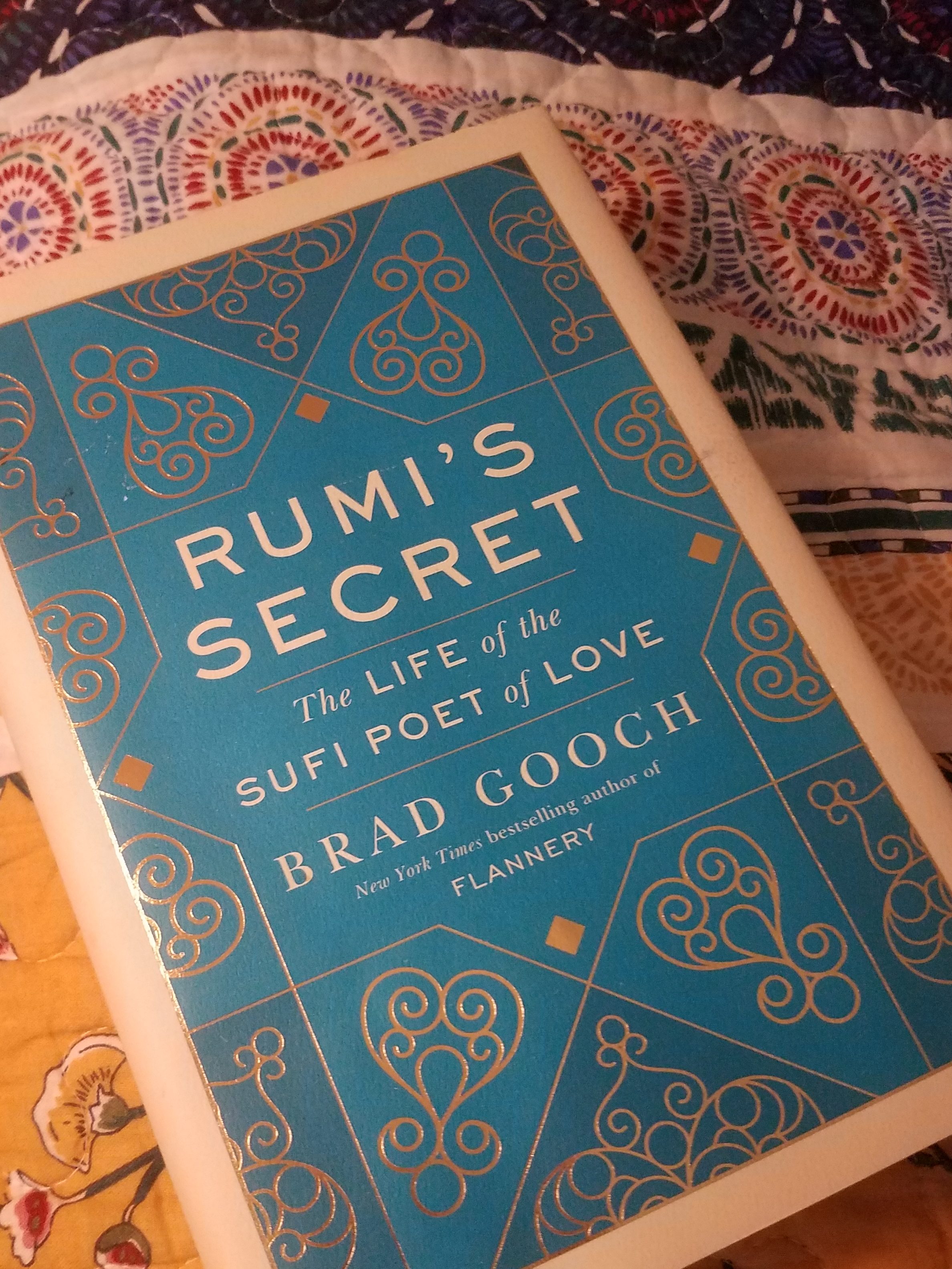
Rumi’s Secret by Brad Gooch
The life of the Sufi poet of love is indeed brought to light in this excellent biography by Gooch. Lovely to note that the biographer’s imagery mirrors Rumi’s.
“As Sultan Valad remembered… ‘[Rumi] went to Damascus like a partridge, and returned to Rum like a falcon. A drop of his soul became as expansive as the sea. The degree of his love became even greater. Because he became like this, don’t ever say, “He didn’t find him.” Whatever he was seeking, he truly found…. His love was filled with waves like a stormy sea….”
Brad Gooch
Stay tuned for a shortlist to follow (heavy on the Salinger) and tomorrow, an archived essay on suicide for Suicide Prevention & Awareness month, but also because this writer gets the sads about her ne’er forgotten dead this time of year.
And please, won’t you continue the exquisite corpse? I am dying for you to drum up some conversation. Leave me a few of your favorite reads in the comments.
 wax poetic exquisite corpse